
Blockchain for Beginners 101: A Guide to Mastering Your Financial Independence
Master the basics of blockchain and decentralization. Learn how self-custody and hardware wallets like Ledger or Trezor can secure your financial independence and help you escape the traditional system.

Financial independence isn't just about how much money you have in the bank. It's about who controls that money. If a single central authority can freeze your account, devalue your currency, or block your transactions, you aren't truly free. You are a tenant in someone else's financial system.
Blockchain technology changes that. It isn't just a buzzword or a playground for tech geeks. It is a tool for your financial sovereignty.
At Garvin Academy, we’ve spent over 20 years teaching people how to build resilient, independent lives. Whether it’s securing your data or building a home-based business, the goal is always the same: be your own boss. Blockchain is the ultimate extension of that philosophy.
Here is your no-nonsense guide to mastering the basics of blockchain and taking the first step toward true financial independence.
What is Blockchain? (The Simplified Version)
Forget the jargon for a second. Imagine a giant, digital notebook. Every time money moves, it gets recorded in this notebook. In the traditional world, the bank owns the notebook. They decide what gets written, and they can erase or change entries if they want.
Blockchain is a ledger where everyone has a copy of the notebook.
The power of decentralization
When a ledger is decentralized, it means no single company, government, or person controls it. Thousands of computers (nodes) around the world verify every transaction simultaneously.
- Immutability: Once a transaction is written, it cannot be deleted.
- Transparency: You can see exactly where the money goes without needing a middleman.
- Security: Since there is no central server to hack, the system is incredibly resilient.
By using blockchain, you are opting out of a system built on trust in institutions and opting into a system built on math and transparency.

The Key to the Kingdom: Self-Custody
If you bought crypto on an exchange like Coinbase or Kraken and left it there, you don't own it yet. You have a promise from the exchange that they will give it to you when you ask. But if they go bankrupt or freeze your account, your "money" disappears.
To be truly independent, you must practice self-custody.
Wallets and private keys
In the blockchain world, your "wallet" doesn't actually hold your coins. Your coins live on the blockchain. The wallet holds your private keys, the digital signature that proves you own those coins.
- Public Key: Like your email address. You give this to people so they can send you money.
- Private Key: Like the password to your email. Never share this.
The 24-word seed phrase
When you set up a self-custody wallet, you’ll be given a recovery phrase (usually 12 or 24 words). This is the master key to your wealth. If your computer breaks or you lose your wallet, these words will restore your funds on any device.
Write them down on paper. Lock them in a safe. Never save them in a digital file or photo.

Professional Independence: Hardware Wallets
If you are serious about investing in yourself and securing your future, you cannot rely on "hot wallets" (apps on your phone or computer that are always connected to the internet). They are vulnerable to malware and hackers.
You need a hardware wallet. This is a physical device that keeps your private keys offline, even when you are making a transaction. It is the gold standard for security.
Our top recommendations:
- Ledger Nano X: This is a fan favorite for its ease of use and Bluetooth connectivity, allowing you to manage your assets from your phone securely.
- Trezor Model T: Known for being open-source and highly transparent. It features a touch screen that makes entering your PIN much safer. [Don't buy from Amazon! Buy from the company's website]
Real action item: If you have more than $500 in crypto, buy a hardware wallet today. It is a small investment for the peace of mind it provides.

Avoiding the Wolves: Scam Protection
The freedom of blockchain comes with the responsibility of self-protection. There is no "customer service" to call if you send your money to a scammer.
Red flags to watch for:
- "Guaranteed" Returns: If an investment promises 1% a day or "no risk," it is a Ponzi scheme. Period.
- Urgency: Scammers want you to act before you think. If someone is pressuring you to "act now or lose out," walk away.
- Support DMs: No legitimate company will ever DM you first on Twitter, Discord, or Telegram to "help" you with your wallet.
- Seed Phrase Requests: No website or person will ever need your 24-word phrase for a legitimate reason. Anyone asking for it is a thief.
Your goal is to build a sustainable, long-term wealth strategy. Don't let the desire for a "quick win" destroy your progress.
Escaping "The System"
Why does all of this matter? Because the traditional financial system is fragile. Banks fail. Inflation eats your savings. Governments can change the rules of the game overnight.
Blockchain provides a parallel system. It allows you to:
- Send money anywhere in the world instantly, without asking for permission.
- Store your wealth in an asset that cannot be printed into oblivion (like Bitcoin).
- Interact with decentralized finance (DeFi) to earn interest without a bank taking a cut.
This is about more than just "crypto investing." It is about financial independence. When you own your keys, you own your future. You become your own bank. You become un-cancelable.
Frequently Asked Questions
Is blockchain the same as Bitcoin?
No. Blockchain is the technology. Bitcoin is the first and most famous application of that technology. Think of blockchain as the internet and Bitcoin as email.
Can I lose my money if I lose my hardware wallet?
No: as long as you have your 24-word seed phrase. The device is just a gateway. If you lose it, you buy a new one, enter your phrase, and your funds are back.
Is it too late to get started?
Absolutely not. We are still in the "early adopter" phase of this technology. The best time to start was ten years ago; the second best time is today.
How do I know which coins to buy?
We focus on fundamentals, not hype. Avoid the "meme coins." Focus on established projects with real utility. Our Crypto Master Course walks you through exactly how to evaluate projects.
Take Action Today
Don't just read this and move on. Invest in yourself. The skills you learn today about digital privacy and blockchain security will be the most valuable assets you own in the coming decade.
- Secure your assets: Get a hardware wallet like the Ledger Nano X.
- Educate yourself: Don't guess. Follow a proven framework.
- Join the community: Surround yourself with people who value independence as much as you do.
Ready to go deeper? Join the Garvin Academy Crypto Master Course and master the technical skills needed to protect your wealth and grow your independence in a digital world.
Excerpt: Master the basics of blockchain and decentralization. Learn how self-custody and hardware wallets like Ledger or Trezor can secure your financial independence and help you escape the traditional system.
SEO Title: Blockchain for Beginners 101: Guide to Financial Independence
Meta Description: Start your journey to financial freedom with our blockchain 101 guide. Learn about decentralization, self-custody, and how to protect your assets from scams.
Tags: Blockchain, Cryptocurrency, Financial Independence, Self-Custody, Ledger, Trezor, Crypto Security, Garvin Academy
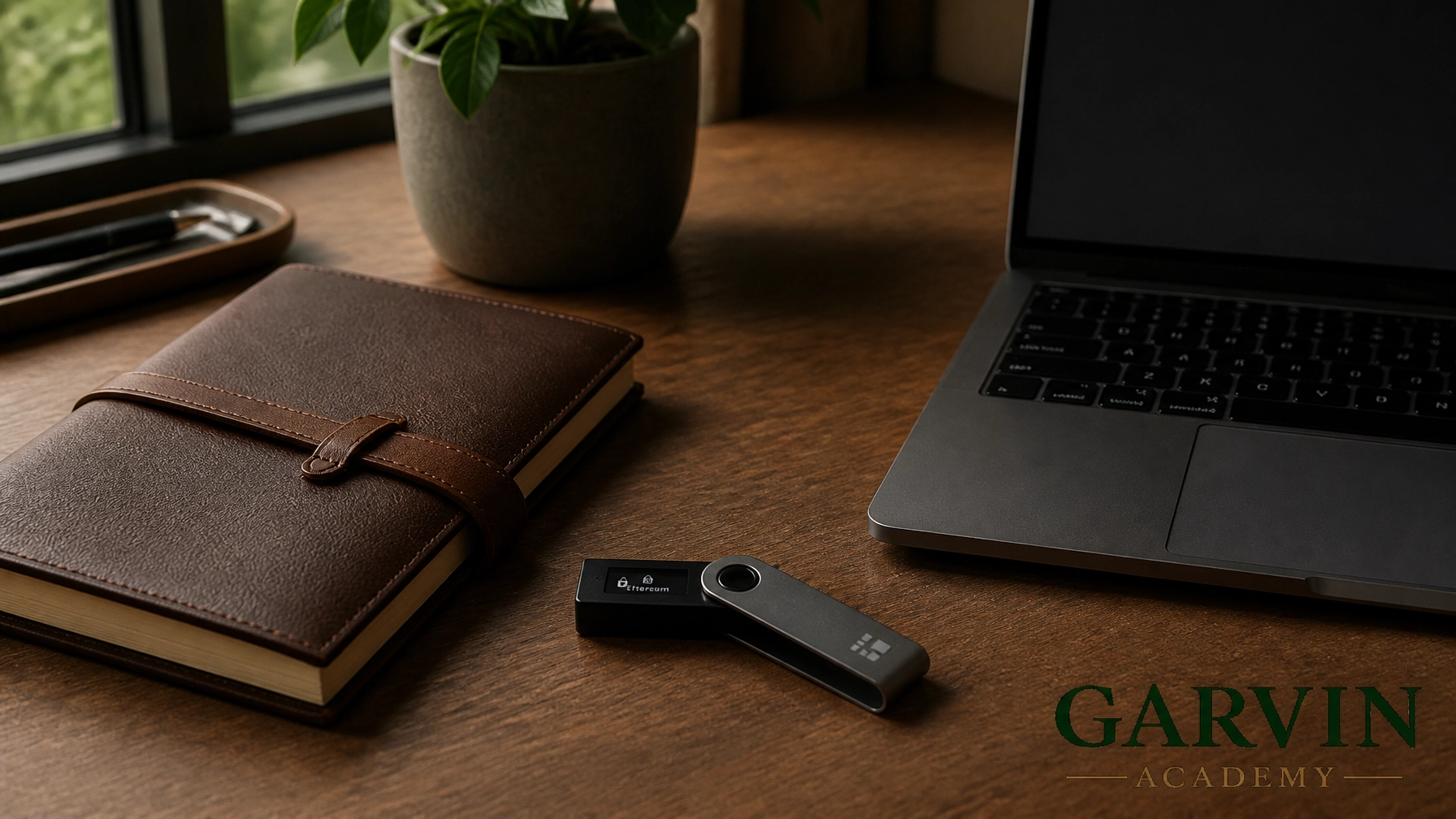
Featured Image Caption: An entrepreneur in a professional home office setting, focusing on mastering blockchain technology to secure his financial future.
Featured Image Link: https://cdn.marblism.com/_7WcZWA14nj.webp

Category: Cryptocurrency & Digital Assets
Related articles
 Cryptocurrency / Digital Assets
Crypto 101: Beginner’s Guide to Digital Asset Security
Master the basics of blockchain and digital asset security. This guide covers self-custody, hardware wallets, and how to avoid common scams to protect your financial freedom.
 Cryptocurrency / Digital Assets
Crypto for Survival: 5 Steps to Protect Your Wealth Outside the Banks
Learn how to secure your wealth with Bitcoin and XRP. This guide covers hardware wallets, cold storage, and surviving a banking collapse.