
Crypto for Survival: 5 Steps to Protect Your Wealth Outside the Banks
Learn how to secure your wealth with Bitcoin and XRP. This guide covers hardware wallets, cold storage, and surviving a banking collapse.

The modern financial system is more fragile than most people care to admit. From sudden bank closures to sweeping policy changes and data breaches, your hard-earned money is often at the mercy of institutions that don't prioritize your independence. If you want true financial sovereignty, you have to look outside the traditional banking walls.
Cryptocurrency isn't just a speculative "side hustle" or a tech trend. For those focused on self-reliance, it is a powerful tool for survival. When used correctly, digital assets allow you to move, store, and protect your wealth without needing permission from a central authority.
But there’s a catch: you are the bank. That means you are responsible for your own security. If you lose your keys, you lose your money.
Here is a 5-step roadmap to securing your wealth outside the banks using survival-grade crypto practices.
1. Choose self-custody over convenience
The first rule of crypto survival is simple: Not your keys, not your coins.
If you keep your Bitcoin or Ethereum on a popular exchange (like Coinbase or Binance), you don't actually own those assets. You own a "promise" from the exchange to pay you. If that exchange freezes your account, goes bankrupt, or gets hacked, your wealth is gone.
Self-custody means you hold the private keys. This removes "counterparty risk", the risk that a third party will fail you. Transitioning to self-custody is the single most important step you can take toward true financial independence.
- Avoid leaving funds on exchanges. Use them only as "on-ramps" to buy your coins, then move them immediately.
- Embrace the responsibility. Understand that there is no "forgot password" button in the world of self-custody.
2. Set up your hardened digital vault
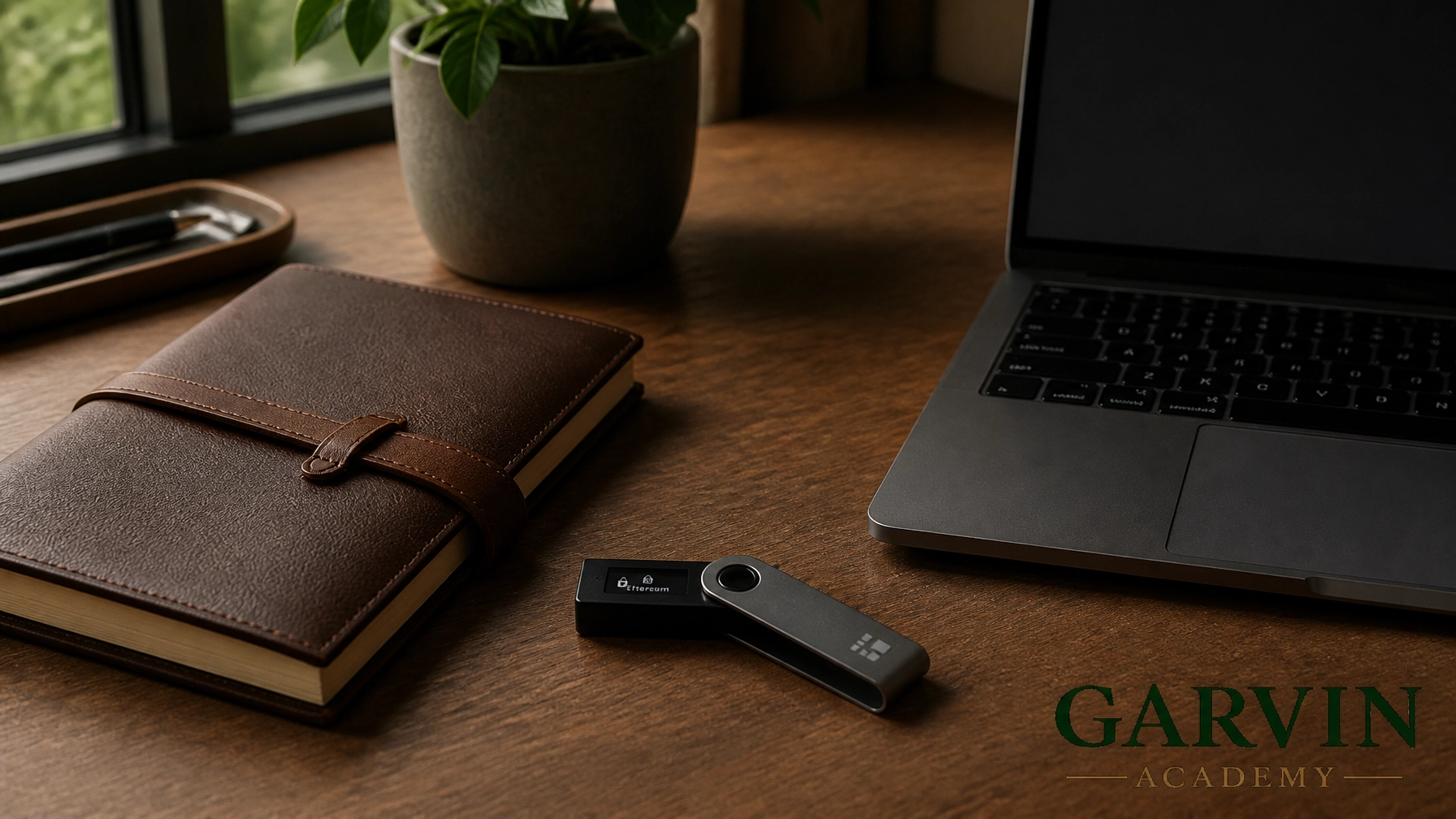
To manage self-custody safely, you need a hardware wallet. This is a physical device that keeps your private keys offline, away from hackers and malware. Think of it as a high-security vault for your digital life.
I recommend the Ledger Nano X. It’s a battle-tested device that offers the perfect balance of security and usability.

How to set it up for maximum security:
- Buy direct or from trusted sources. Never buy a "used" hardware wallet. Ensure the shrink-wrap and security seals are intact.
- Initialize as a new device. Follow the on-screen prompts on the device itself, not just the computer app.
- Set a strong PIN. Don't use your birthday or "1234." Choose a random 8-digit code and memorize it.
By keeping your keys on a device like the Ledger, you ensure that even if your computer is infected with a virus, your crypto remains safe because the "signing" of transactions happens inside the hardware, not on your PC.
3. Protect the "Master Key" (Your Seed Phrase)
When you set up your hardware wallet, it will generate a 24-word recovery phrase (also called a seed phrase). This is the most important piece of data you will ever own. If your Ledger is lost, stolen, or crushed by a tank, these 24 words can recreate your entire wallet on a new device.
However, if someone else gets these 24 words, they can steal everything you own in seconds.

Survival-grade seed phrase rules:
- Never type it into a computer. Not in an email, not in a "notes" app, and definitely not in a photo on your phone.
- Write it down physically. Use the cards provided with your device, or better yet, use a metal backup tool.
- Go metal for fire resistance. Paper burns. Ink fades. A stainless steel or titanium seed plate can survive house fires, floods, and decades of decay.
- Use a passphrase (The 25th word). For advanced users, adding an extra passphrase adds a layer of "plausible deniability" and protects you even if someone finds your 24 words.
Your goal is to make sure your master key is accessible to you in an emergency, but impossible for anyone else to find or use.
4. Build redundancy into your plan
In a survival situation, "one is none, and two is one." You need redundancy. If your only backup of your seed phrase is in your house and your house is destroyed, your wealth is gone.
You need a distributed backup strategy that covers multiple failure points:
- Geographic separation. Keep one copy of your seed phrase in a secure safe at home. Keep a second copy in a different physical location, perhaps a safe deposit box or a trusted family member's safe.
- The "3-2-1" rule for crypto. Have 3 copies of your phrase, in 2 different formats (e.g., one paper, two metal), with 1 copy located off-site.
- Incapacity planning. Does your spouse or heir know how to access these funds if something happens to you? Create a "Legacy Letter" that explains the process without necessarily revealing the 24 words themselves.
Effective preparedness is about planning for the "what ifs" before they happen.
5. Practice strict Operational Security (OPSEC)
The biggest threat to your crypto wealth isn't a high-tech hacker in a basement; it's social engineering and poor digital hygiene. Protecting your wealth outside the banks requires a "Grey Man" approach, blending in and not making yourself a target.

Daily action items for crypto survival:
- Don't talk about your holdings. The first rule of Crypto Club is you do not talk about how much crypto you have. Bragging makes you a target for "wrench attacks" (physical coercion).
- Use a dedicated device. If possible, use a separate, "clean" laptop or tablet specifically for your financial transactions. Don't use this device for social media, gaming, or clicking random links.
- Enable Hardware MFA. For any exchanges or email accounts you must use, never rely on SMS (text message) codes. Use a hardware security key like a YubiKey or at least an app-based authenticator (like 2FAS).
- Verify everything. Before sending a transaction, verify the recipient address on your Ledger's physical screen. Malware on your computer can "swap" addresses in your clipboard, but it cannot change what the hardware device displays.
Take control of your future
Moving your wealth into crypto and securing it yourself is a declaration of independence. It requires effort, education, and a commitment to personal responsibility. But the reward, true financial freedom and a hedge against systemic collapse, is worth every minute of the work.
If you are ready to stop being a "customer" and start being your own bank, it's time to dive deeper.
Ready to master your digital assets? Join the Garvin Academy Crypto Master Course and learn the exact frameworks I use to protect wealth and maintain privacy in a digital world.
FAQ: Common crypto survival questions
Is crypto legal?
In most jurisdictions, yes. However, regulations are constantly changing. Always stay informed about the laws in your specific area. Crypto is about privacy, not breaking the law.
What happens if I lose my Ledger device?
Nothing, as long as you have your 24-word recovery phrase. You simply buy a new device and enter the phrase to restore your funds. The device is just a key; the money lives on the blockchain.
Can I use crypto if the internet goes down?
You need an internet connection to send a transaction to the network. However, your wealth is safely stored even if you are offline. In a long-term grid-down scenario, crypto becomes less liquid, which is why it should be part of a diversified preparedness plan that includes cash and physical supplies.
Which coins are best for "survival"?
Bitcoin is widely considered the "Gold Standard" due to its decentralization and security. Some also look at Monero for enhanced privacy or stablecoins (like USDC) for short-term price stability, though stablecoins carry their own risks.
About the author: Forrest Garvin
Forrest Garvin is a U.S. Air Force veteran, author, and the founder of Garvin Academy. With over 20 years of experience in the survival and preparedness industry, Forrest has helped thousands of individuals take back control of their privacy and financial independence. He is the author of The Preparedness Roadmap and the founder of PrepperNet, a global community of over 100,000 members. His mission is to provide practical, real-world training that empowers families to thrive in an uncertain world.
Summary:
- Excerpt: Stop relying on fragile banks. Learn 5 practical steps to secure your wealth using crypto, hardware wallets, and survival-grade security protocols.
- SEO Title: Crypto for Survival: Protect Wealth Outside Banks | Garvin Academy
- Meta Description: Discover how to use cryptocurrency for financial independence and survival. 5 actionable steps to secure your assets outside the banking system using hardware wallets and OPSEC.
- Tags: Learning Crypto, Crypto Master Course, financial independence, side hustle ideas, privacy, preparedness, self-custody.
- Featured Image Caption: Bitcoin and XRP coins on a wooden table with Garvin Academy logo
- Category: Cryptocurrency & Digital Assets
Related articles
 Cryptocurrency / Digital Assets
Crypto 101: Beginner’s Guide to Digital Asset Security
Master the basics of blockchain and digital asset security. This guide covers self-custody, hardware wallets, and how to avoid common scams to protect your financial freedom.
 Cryptocurrency / Digital Assets
Seed Phrase Backup: Protect Your Crypto Recovery Phrase in 2026
Learn how to create, store, and verify a crypto seed phrase backup in 2026. Get practical steps for protecting self-custody crypto without adding unnecessary digital risk.
 Cryptocurrency / Digital Assets
Blockchain for Beginners 101: A Guide to Mastering Your Financial Independence
Master the basics of blockchain and decentralization. Learn how self-custody and hardware wallets like Ledger or Trezor can secure your financial independence and help you escape the traditional system.